

Today, we have an assessment of Mario Draghi’s competitiveness recommendations a year on, preview this afternoon’s tabling of the Mercosur trade agreement, and new research suggesting green policy opponents are quietly profiting from it.
Sub Mario
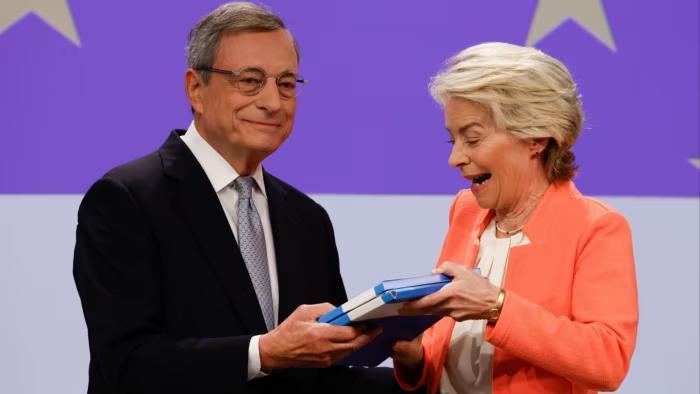
Almost one year since Mario Draghi published a report on European competitiveness, only one in 10 of its recommendations has been carried out, according to a new analysis seen by Alice Hancock.
Context: The former European Central Bank president last September warned that Europe was facing an “existential challenge”. His report made 383 recommendations to boost economic growth, including unifying the bloc’s capital markets, aligning business rules across countries and strengthening supply chains.
But advocates for the report’s findings fear that European Commission president Ursula von der Leyen is “dragging on Draghi”, said João Cotrim de Figueiredo, a vice-president for the liberal Renew group in the European parliament.
Europe has its “pants on fire” when it comes to its sluggish economy, Cotrim de Figueiredo said. Even if he did not agree with all of the recommendations, the report “should be the blueprint for the commission’s activities in this mandate” and applied with “urgency”, he added.
Analysis by the European Policy Innovation Council, which will be presented by Renew today, shows that 11.2 per cent of Draghi’s recommendations have been implemented. A fifth have been partially implemented.
Most progress had been made on recommendations for the transport and critical minerals sector, while laggards included digitalisation, cleantech and energy, the research found.
In response, the commission said in a statement that it “has acted quickly to implement its key recommendations to boost Europe’s competitiveness”, listing initiatives taken in line with Draghi’s suggestions. “We will continue to advance these initiatives and more to come to strengthen Europe’s competitiveness.” Antonios Nestoras, founder of EPIC, said that one of the issues with Draghi’s report was that it was “too big and too technical” to be easily tracked.
Cotrim de Figueiredo said the researchers had used an artificial intelligence tool to run through the EU’s legislative database to measure which proposals were most burdensome — and which MEPs and commissioners were adding most complexity to legal texts.
Chart du jour: Guns and butter
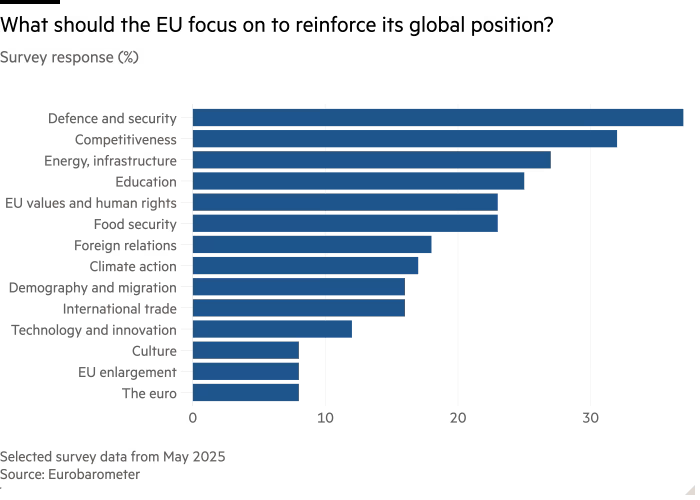
EU citizens want the bloc to focus on defence and economic competitiveness, according to a Eurobarometer survey published today.
Crunch time
The European Commission is expected to offer reassurances to farmers as it tries to sell the blockbuster Mercosur trade deal today to member states and MEPs, writes Andy Bounds.
Context: The commission will finally table the agreement, sealed in December, which is deeply unpopular with farming states as it would allow South American countries to send more beef, chicken and other foodstuffs to the EU.
A majority of MEPs, and a qualified majority of member states, need to vote in favour for it to come into force.
Brussels is pinning hopes on provisions that allow it to stop or reverse gradual tariff reductions if there is evidence it is damaging the EU agricultural sector.
Given that the tariff-free quotas account for 1.5 per cent of EU beef consumption and 1.3 per cent of chicken, officials do not believe they will be used.
But will that be enough for France, Poland and other opponents to change their minds? Belgium is also expected to not vote for the deal, officials told the Financial Times.
Copa-Cogeca, the farmers’ group, said the decision to push for ratification “is deeply damaging and sends yet another negative signal at the start of this new political season”.
Herbert Dorfmann, agriculture spokesperson for the centre-right EPP, said it supports the deal “but not on the backs of our farmers”.
Underdogs
Poland and Hungary are typically the two EU countries most opposed to ambitious climate legislation, but a new analysis shows they are racing ahead with battery manufacturing and cleantech jobs, writes Alice Hancock.
Context: EU countries are currently debating an emissions reduction target for 2040, which Brussels has proposed should be 90 per cent compared to 1990 levels. Hungary and Poland have consistently voted against efforts to enact more ambitious climate legislation.
But new research from the Brussels-based think-tank Bruegel shows that Poland and Hungary are the two countries with the most operational battery manufacturing capacity.
Hungary is building new facilities that will have a production capacity of more than 100GW in batteries, more than doubling its current capacity, Bruegel found in its European Clean Tech Tracker to be published today at its annual meetings.
Despite being highly vocal on the EU need to purchase Russian gas, Hungary has also outpaced Sweden and Finland, among the most ambitious countries on climate, on clean technology jobs in sectors such as wind, solar and bioenergy. In 2023, Hungary had around 8,100 cleantech jobs, of the 33,000 in the whole EU.
“Hungary and Poland paint a paradoxical picture: both have welcomed foreign investment into clean tech factories, boosting jobs and exports, yet remain far less enthusiastic about shaping climate regulation in Brussels,” said Ben McWilliams, affiliate fellow at Bruegel.
EU member states are expected to vote on the EU’s 2040 target later this month.
Related Articles
The unfortunate EU foot-dragging on the Draghi plan
Europe’s competitiveness is waning due to inertia in Brussels and national capitals
Read More
Why European workers need to switch jobs
The continent’s labour market is ill-suited to an age of disruption
Read More
Draghi’s Tough Love One Year After Wake-Up Call Report
Former ECB chief warns that continued inaction threatens the EU’s competitiveness and sovereignty.
Read More