

HOWDY. Sarah Wheaton here, welcoming all of you to this Tuesday edition of Brussels Playbook — but especially to Carrie Budoff Brown, who officially makes her triumphant return to the POLITICO Europe newsroom today.
Kathryn Carlson will be the rapporteur (to use some Parliament jargon, in honor of the plenary, of course) for Wednesday’s pre-SOTEU edition of Brussels Playbook.
DRIVING THE DAY: RIBERA VS. VDL
TERESA RIBERA, COMMISSIONER IN COMPETITION: The centralized command structure of Ursula von der Leyen’s second Commission is facing a rebellion from her No. 2, Teresa Ribera. The only surprise is that it took this long.
Breaking ranks: Less than a week after Ribera, the executive vice president for competition, used a speech in Paris to defy the anodyne Berlaymont lines-to-take by calling out a “genocide” in Gaza, she was AWOL at what should have been a big moment directly related to her job. She did not hold a press conference to announce a landmark edict against one of the world’s most ubiquitous companies, Google.
The intrigue: According to a report Monday, that was not her choice.
The Commission is pushing back hard against a dispatch in The Capitol Forum by veteran competition reporter Javier Espinoza that said Ribera was “blocked” from holding a press conference, citing “people with direct knowledge of the top EU official.”
That was then … In Margrethe Vestager’s time as competition commissioner, Big Tech fines were trumpeted to a full press room at midday. My colleague Francesca Micheletti recalls how the Danish commissioner used to prance on stage, usually wearing a brightly colored outfit and a smile, to proudly explain how the EU executive protected its consumers by keeping markets fair and open.
This is now … Yet for this alpha move against Alphabet, the Commission offered merely a humble briefing with technical policy experts, speaking on the condition of anonymity. The lack of a political Q&A session on Friday drew howls from reporters that continued into this week.
Busy packing: The Commission’s line is that everyone agreed that this was the most practical way to go. At the press briefing on Monday, Arianna Podestà, the Commission’s No. 2 spox, cited logistics. Ribera “was traveling to Ethiopia very early Saturday morning,” she said, referring to the executive vice president’s mission to Addis Ababa for the Africa Climate Summit. (In an echo of last week’s GPS-jamming drama, the SPP is being contradicted on the flight timing; Playbook hears the voyage was actually Saturday evening.)
And also it was late: The decision was apparently adopted earlier that day, making it difficult to arrange a proper announcement at midday. But Brussels bubble reporters are used to much worse than a press conference at 5 p.m. on a Friday — especially if it’s about a hot antitrust matter which is bound to infuriate U.S. President Donald Trump. (Which it very much did. Now that Trump has threatened to retaliate, my colleague Jacob Parry has this look at what’s next, for Competition, Tech and Trade Pro subscribers.)
Free agenda: But the Spanish commissioner, POLITICO can also report, was in the Berlaymont building on Friday afternoon, apparently available, with her public agenda void of commitments.
Who decides? Commissioners can’t just up and hold a press conference. They need clearance from the spokespersons’ service, which decides in consultation with the Commission president’s cabinet. In other words, it’s von der Leyen who decides who gets to go on stage. And in this case, evidently, she decided it was best for Ribera to remain on the sidelines — or rather, upstairs.
CONTAINMENT STRATEGY FALLS FLAT: The lack of a Vestager-style unveiling is illustrative of the very different vibe in von der Leyen’s second Commission. Her first included not just the Danish competition cop, but also the crusading climate czar Frans Timmermans and Thierry Breton, known for his confrontations with Elon Musk and von der Leyen herself.
So it was something of a headscratcher when von der Leyen named Ribera, a widely respected climate diplomat — the only Commission nominee with the gravitas and chutzpah to potentially outshine her — as her second-in-command. (Ribera even briefly helmed the Commission while von der Leyen was recovering from pneumonia earlier this year.) What’s more, Ribera was nominated by Spain’s Socialist prime minister, Pedro Sánchez, and her brand — saving the planet — seemed like an awkward match with the European People’s Party mantra of deregulation and cutting red tape.
Don’t forget: Back in May 2024, months before von der Leyen offered her a top post, Ribera condemned von der Leyen’s climate climbdown as showing “an attitude of resignation that is enormously pernicious” and “enormously harmful to European interests,” in an interview with POLITICO.
Ribera keeps it real: If von der Leyen was trying to “keep your enemies closer” with Ribera, it seems not to be working. The EVP has increasingly gone off script, not only on Gaza but also on the trade deal with Trump. The outward rebellion comes as Ribera has found herself isolated and facing attacks from outside and inside the Commission, as my colleague Karl Mathiesen described in this deeply-reported piece from July.
Playbook thought bubble: Despite the categorical denials, the 13th floor would have had plenty of reasons to prefer that Ribera skip the Google press gaggle. We could easily see it having gone off the rails on Gaza, or turning into an extra display of defiance against Trump while Brussels is trying to project some rhetorical deference.
Back on message: By Monday evening, everyone was falling in line. “There was full internal agreement ” on sticking to the technical briefing and press release, Podestà said in a statement. “Therefore, these reports do not correspond to reality.” Simultaneously, Playbook received a statement from a senior Ribera cabinet official: “Given the adoption of the decision on a Friday evening, it was considered to be more appropriate to have a statement and a technical briefing.”
Back from Africa: Ribera is due in Strasbourg today where, presumably, she will finally meet the press.
POLLING DEPT
SURVEY — SLIM MAJORITY WANT VDL OUT: Some six in 10 Europeans polled in a new survey say they think Ursula von der Leyen should resign as Commission president.
That’s harsh, man: A poll out this morning in Le Grand Continent, conducted in five EU countries, finds profound dissatisfaction with the EU’s trade agreement with Washington. Some 52 percent said they felt “humiliated” when they learned about the deal, and three-quarters of respondents said von der Leyen had failed to defend European interests.
Strategic divide: Perhaps reflecting the divide between the approaches of von der Leyen and Ribera, four in 10 said they want to see the EU take a stance of “opposition to the U.S. government” rather than alignment and compromise.
Eurobarometer, meet Eurobazooka: Conducted by Cluster17 in late August and early September, the Eurobazooka poll included around 1,000 respondents from each of these countries: Spain, France, Germany, Poland and Italy.
HAPPY BIRTHDAY TO ‘SLOW AGONY’
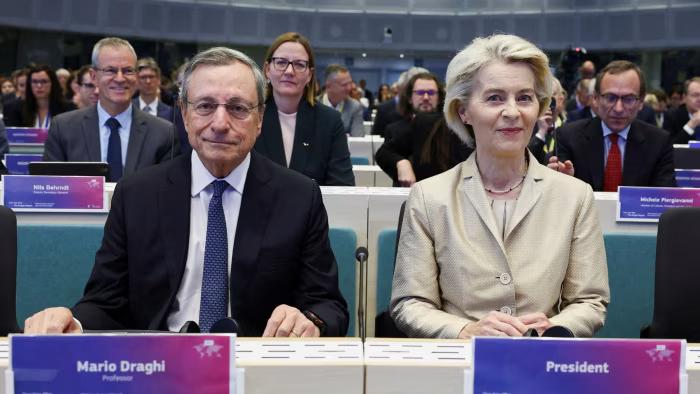
SHOT: “The Draghi report has become the economic doctrine of the EU, and everything we’ve proposed since has been aligned with it,” Stéphane Séjourné, the Commission executive vice president charged with industrial strategy, told POLITICO.
CHASER: Only 11 percent of the recommendations in the report by the ex-Italian PM and central banker Mario Draghi had been enacted in the year since it was published, per a report by the European Policy Innovation Council think tank. (Séjourné, for what it’s worth, blamed the lag on the capitals.) Read more from Carlo Martuscelli and Giovanna Faggionato here.
NO PROGRESS ON ENERGY PRICES: In the field of energy, no actions have been completed at all. While the security of supply is no longer at risk, prices have become the biggest threat to Europe’s energy resilience.
Pocketbooks, populism and profits: “It affects not only citizens’ trust, but also the capacity of businesses to compete globally,” cautions an assessment from the Center for the Study of Democracy, set to be unveiled today in Washington. Hanne Cokelaere and Gabriel Gavin got an early look and crunched the numbers.
SOTEU PREP
FANTASY SOTEU: POLITICO’s crack policy reporters teamed up to bring you this advance text of von der Leyen’s State of the European Union speech. Check against delivery — and let us know if we nailed her policy pronouncements, evasions, aspirations and overused expressions. Read it here.
VIBE CHECK — RULES DEFINITIVELY BROKEN: With the rules-based order beyond repair, the EU needs to either embrace the law of the jungle — or make up some new rules, argues the Commission’s annual foresight report. It’s due to be presented later today, but Pieter Haeck already got a peek.
THE DEAD FILES CLUB: The European Commission has launched a review of the hard-to-pass draft legislation languishing on officials’ to-do lists, with a view to revising or retracting proposals it can’t pass. Two officials who spoke to POLITICO confirmed that the influential secretariat-general had asked departments to compile a list of files stuck in the system for more than two years as part of the process.
Sitting on the shelf: The draft bills, deadlocked because of a lack of support in Parliament or objections from EU member countries, will be reassessed to ensure they still align with the Berlaymont’s priorities. The move comes amid a push for efficiency across the executive, with a restructure underway to deliver better cost-effectiveness and more focused governance. Gabriel Gavin and Eliza Gkritsi have the story for Pro subscribers.
CIVIL SOCIETY BROADSIDE AGAINST “DEREGULATION TSUNAMI”: Some 470 civil society organizations have signed on to a statement blasting the Commission’s tape-cutting mission. It’s led by the watchdog NGO Corporate Europe Observatory (CEO); trade union EPSU; green groups European Environmental Bureau, Friends of the Earth Europe, CAN Europe and Global 2000; and digital rights advocates EDRi. “We call for more protections, not fewer,” the statement concludes.
WHILE CORPORATES SURF THE WAVE: Right in the opposite corner were 39 CEOs from well-known technology companies (among them Bosch, SAP, Nokia, Philips) and national technology associations. They write in an open letter seen by my colleagues over at Morning Tech that “we believe the direction set by this Commission is right.”
NEIGHBORHOOD TENSIONS
“BELGRADE, WE HAVE A PROBLEM:” With long-running protests and a heavy-handed police crackdown underway in Serbia, the EU is hardening its stance towards the country — theoretically still a candidate to one day join the bloc despite backsliding on democratic values.
“There’s been a mood change in the Commission in recent weeks — we’re seeing support for a new stance on Serbia,” one official told Gabriel Gavin ahead of today’s planned appearance in the European Parliament by Enlargement Commissioner Marta Kos. She’s been escalating her rhetoric against Belgrade, and is expected to call on Serbia to clearly say whose side it’s on after President Aleksandar Vučić flew to Russia and China to take part in recent celebrations.
Dimming view of Vučić: As Serbia’s student resistance movement grows, Vučić sparked outrage on Friday when he referred to European politicians who supported the anti-government demonstrators as “scum.”
Watch your words: Kos has now waded into the row, telling reporters in Vienna that the comments showed Vučić has “a questionable understanding of democracy.” According to her, “in Belgrade, we have a problem,” urging the government to instead focus on restoring media freedoms, building an independent judiciary and ending violence at the hands of authorities.
**IAA MOBILITY in Munich: Experience the future of mobility at the mobility event of the year through September 14 and discover under the slogan “It’s all about MOBILITY” mobility solutions from around the world. Connect with top companies and international stakeholders— at the Munich Trade Fair Center and downtown Munich.**
HAUNTING WORDS
LISBON DISASTER AFTERMATH: Lisbon Mayor Carlos Moedas — a familiar figure in Brussels for those who remember his days as research commissioner — is swiping away calls to step down in the wake of last week’s deadly funicular disaster. Opposition lawmakers are using the politician’s own words against him in a bid to force his resignation.
Glass houses: In 2021, Moedas’ predecessor as mayor, Fernando Medina, came under fire after his administration admitted it had shared the personal information of locally-based Russian dissidents with Russian authorities. Moedas, then the center-right candidate for mayor, insisted Medina had to step down. “City Hall put these people in mortal danger,” he told POLITICO at the time.
Not the same: Four years later, national figures from across the ideological spectrum are resurfacing those quotes and demanding Moedas take political responsibility for the funicular disaster, which they blame on his administration’s lackluster maintenance of transport infrastructure. But Moedas told POLITICO’s Aitor Hernández-Morales the tragedy couldn’t be compared with the scandal that embroiled his predecessor because it was not “attributable to a decision made by the mayor.”
Voters decide: With local elections set to be held next month, Moedas is unlikely to get a break from his political rivals.
IN OTHER NEWS
CENTER-LEFT WINS IN NORWAY: The Labor Party of Prime Minister Jonas Gahr Støre has secured another term in power after a bloc of center-left parties narrowly won Norway’s general election Monday. On the right, the populist Progress Party surged to its best result in a national election, doubling its support and overtaking the Conservatives as the largest opposition force in parliament. POLITICO has more.
SHATTERED CONFIDENCE: French President Emmanuel Macron’s office said he would move in “the next few days” to appoint his fifth prime minister in less than two years after François Bayrou was toppled in a no-confidence vote Monday — but there are doubts the new appointee will be any more successful in forcing through the billions of euros of budget cuts needed to save France from a debt crisis. Clea Caulcutt examines Macron’s bleak options as he seeks to hold together a country that looks increasingly ungovernable.
AGENDA
— European Council President António Costa is in Riga where he’ll meet with Latvian Prime Minister Evika Siliņa … in Vilnius, where he’ll meet with Lithuanian President Gitanas Nausėda … and in Warsaw, where he’ll meet with Polish Prime Minister Donald Tusk.
— European Parliament’s plenary session in Strasbourg kicks off at 9 a.m. MEPs will debate devastating wildfires in Southern Europe, the need to strengthen EU aid to restore forests and boosting EU preparedness. Agenda. Watch.
— EU foreign policy chief Kaja Kallas speaks to the Parliament about Ukrainian security guarantees (at 9 a.m.) … about the situation in Gaza … and about Moldova’s resilience against Russian threats.
— Commission Executive Vice President Raffaele Fitto takes part in plenary debates on amending the ERDF, Cohesion Fund and Just Transition Fund as part of the mid-term review … and debates on cohesion policy.
— Climate Commissioner Wopke Hoekstra speaks in the plenary debate on the Carbon Border Adjustment Mechanism.
— Meeting of the College of Commissioners in Strasbourg.
— Commission President Ursula von der Leyen receives Renew Europe Chair Valérie Hayer … receives Martin Schirdewan, co-chair of the Left group in Parliament.
— European Parliament President Roberta Metsola receives Moldova’s President Maia Sandu, who also talks in the parliament at noon.
— NATO Secretary-General Mark Rutte is in the U.K. … attends a meeting of the Ukraine Defense Contact Group.
— Agriculture and fisheries ministers continue their meeting in Copenhagen. Agriculture Commissioner Christophe Hansen and Danish Agriculture Minister Jacob Jensen hold a press conference at 1:15 p.m. Details.
— Culture Commissioner Glenn Micallef hosts a breakfast discussion with coordinators of the Parliament’s Committee on Culture and Education … meets the Intergroup on Traditional Minorities, National Communities and Languages.
BRUSSELS CORNER
WEATHER: High of 21C, sunny intervals.
NEW JOB 1: Agathe Legris, stalwart of POLITICO’s events team who bravely wrangled prickly journalists and demanding corporates alike, started this week as chief of staff at DigitalEurope.
NEW JOB 2: Theo Moore, whose CV includes helming APCO Worldwide’s Brussels office, is decamping to Teneo starting Oct. 1.
GIFT TO KYIV: The Brussels Fire Brigade is donating another four ambulances to Ukraine. Brussels’ State Secretary for Firefighting Ans Persoons told the Brussels Times it was a “clear message of solidarity.” The city has donated several ambulances to Kyiv since 2022.
WELCOME TO PRISON: A former prison in Forest has reopened as a museum, three years after its closure. The site was transformed by the Brussel-based NGO 9m2, which hopes that visitors will “reflect on the necessity and relevance of imprisonment in society,” according to the Brussels Times.
BIRTHDAYS: John A. Clarke, the Commission’s former director of international affairs; AP’s Matt Lee; the Commission’s Emiliano Tornese.
THANKS TO: Francesca Micheletti, Gabriel Gavin, Aitor Hernández-Morales, Pieter Haeck and Karl Mathiesen; Playbook editor Alex Spence, reporter Ferdinand Knapp and producer Dean Southwell.
Related Articles
The unfortunate EU foot-dragging on the Draghi plan
Europe’s competitiveness is waning due to inertia in Brussels and national capitals
Read More
Why European workers need to switch jobs
The continent’s labour market is ill-suited to an age of disruption
Read More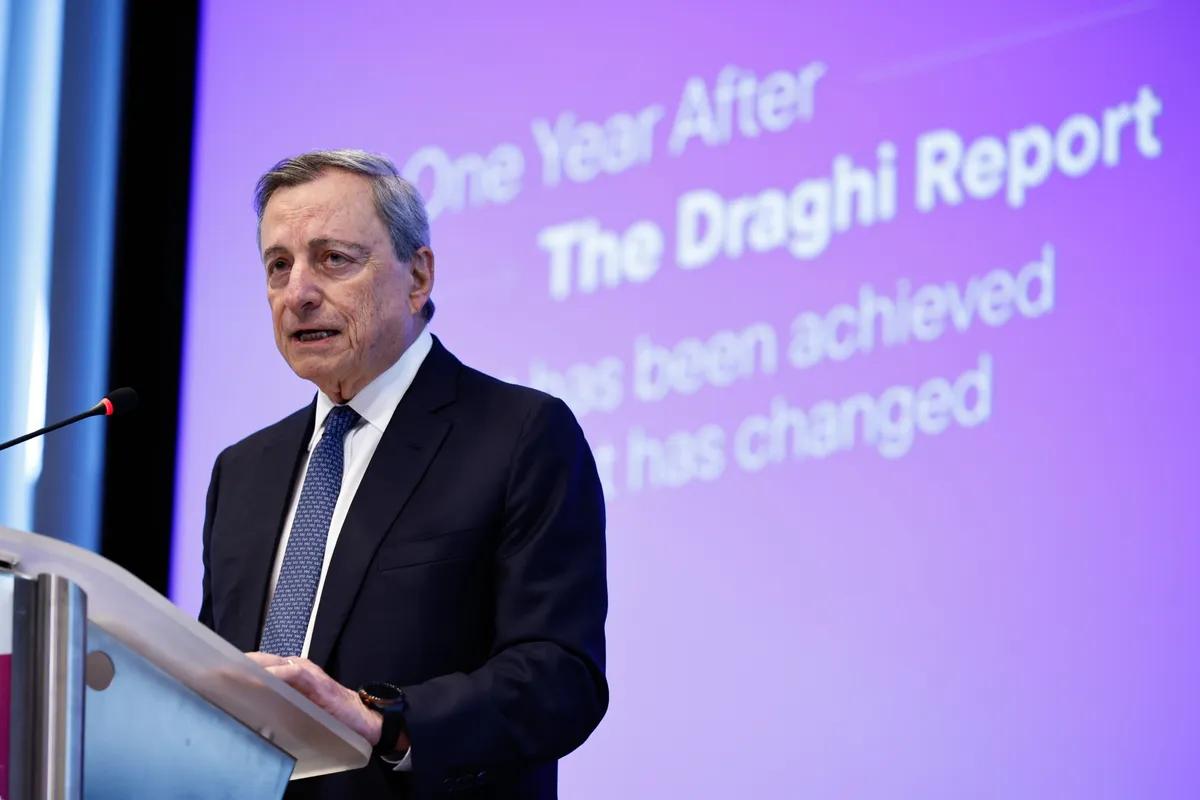
Draghi’s Tough Love One Year After Wake-Up Call Report
Former ECB chief warns that continued inaction threatens the EU’s competitiveness and sovereignty.
Read More